Written by Leon Ximenes, staff writer. Reviewing the trials and labels directly. Last reviewed April 2026.
Here is a question worth sitting with for a moment: if you cannot verify what is actually inside a vial, does the price on it mean anything at all?
That is not a rhetorical trick. It is the situation the peptide market landed in during 2026, and it is why this piece skips the usual “who’s cheapest” framing entirely. Instead, it walks through five plain questions a reader can ask of any provider, questions that, taken together, tell you far more than a price tag ever could.
A quick way to think about value
Value is simple in theory: what you get, divided by what you pay. The trouble starts when nobody can tell you what you’re getting. A vial that might contain the labeled compound at the labeled purity, and might not, with no one accountable either way, isn’t a bargain. It’s a guess with a price attached. Low price times unknown quality doesn’t equal good value. It equals an equation with a missing variable.
Two things happened in 2026 that make this concrete
The first is something reported, not confirmed: the widely discussed shutdown of Peptide Sciences, generally dated to early March 2026. To be fair to the record, this comes from independent analysts and a large number of affiliate blogs, not from any FDA or government filing this piece could verify [C1]. So it’s treated here as background noise, the thing driving a lot of searches, rather than as settled fact. And honestly, the bigger point doesn’t depend on any one seller’s fate.
The second thing is documented, and it matters more. On March 31, 2026, the FDA sent warning letters to a group of online peptide sellers, Gram Peptides and Prime Sciences among them, stating plainly that their products were unapproved new drugs. The “research use only” label didn’t hold up as a defense. In the agency’s own words: “Evidence obtained from your website establishes that your products are intended to be drugs for human use” [C4]. This wasn’t an isolated action. A regulatory-law analysis counted more than fifty FDA warning letters in a single stretch in September 2025 alone, many addressing peptides marketed as “research use only” while being advertised for human use [C5].
What this means for value is straightforward. That “research use only” label was never really about quality. It was a legal shield, one that let sellers avoid promising the contents matched the label for actual human use. Now that a regulator has said, in writing, that the shield doesn’t even protect the seller, the buyer is holding something with no confirmed identity, no confirmed purity, and no one standing behind it. That’s not a discount. That’s a gamble with a fixed cost and no visible odds.
Five questions worth asking before you order anything
Instead of chasing the lowest price, it helps to ask five specific questions about any provider. Each one gets a score from 0 to 2, for a total out of 10.
1. Is anyone accountable? Is there a licensed clinician and a licensed pharmacy standing behind the product, so a problem has an actual owner? Full marks go to a licensed pharmacy filling a prescription. Zero goes to an anonymous seller whose label disclaims responsibility.
2. Is it sourced inside the legal framework? Compounded and dispensed by a 503A or 503B pharmacy under the Food, Drug, and Cosmetic Act, or mailed as an unregulated “research chemical”? In-framework dispensing scores 2; the research-chemical route scores 0.
3. Can you actually see the testing? Is there batch-specific identity, purity, and (for anything injectable) sterility and endotoxin testing that a buyer can view, or just a claim on a label with no method behind it? Published, multi-method, per-batch testing scores 2. A bare assertion scores 0. A generic certificate of analysis on a research chemical earns a partial 1, since it verifies contents but supplies no accountability.
4. Is the provider honest about what it’s selling? Does it say clearly that compounded medicines aren’t FDA-approved, and does it avoid overselling thin-evidence compounds? Given the 2026 enforcement wave, this isn’t a courtesy, it’s the exact behavior regulators are now checking for [C4][C5]. Full disclosure scores 2; marketing that hints at approval or proven results scores 0.
5. Is there anyone checking in afterward? Is there a structure for monitoring and adjusting dose once you’ve placed your first order, or does the relationship end the moment payment clears? A supervised model with real check-ins scores 2; a model that stops at checkout scores 0.
Anyone can run this checklist themselves against any provider. Applied here, the picture is not subtle.
What the checklist actually shows
| Provider | Accountable | In-framework | Verifiable testing | Honest | Follow-up | Total |
|---|---|---|---|---|---|---|
| FormBlends | 2 | 2 | 2 | 2 | 2 | 10 / 10 |
| HealthRX | 2 | 2 | 2 (GLP-1 focus) | 2 | 2 | 9 to 10 / 10 |
| Research-chemical retailers (Amino Asylum, Sports Technology Labs, Pure Rawz, Biotech Peptides, Limitless Life, and similar) | 0 | 0 | 0 to 1 | 0 | 0 | 0 to 1 / 10 |
Notice the shape of that table. It’s not a gentle slope from best to worst. It’s two clusters, one near the top and one near the bottom, split by a single structural fact: whether a licensed person stands between the buyer and the product. Smoothing that into a tidy 1-through-7 list would flatten something real.
FormBlends, walked through question by question
FormBlends earns full marks on every question, and that’s the actual basis for placing it first here, not a price claim.
On accountability and sourcing: the company describes itself as a platform connecting patients to independent, licensed clinicians, who make the prescribing decisions, and every medication requires a licensed physician consultation. When a prescription is written, a licensed 503A pharmacy compounds and dispenses it. Two named, licensed parties, both scoring 2.
On testing: FormBlends states its compounded medications come from licensed 503A pharmacies following USP <797> and <800> standards, with per-batch checks that include HPLC for purity, mass spectrometry for identity, and endotoxin testing for sterility. This is the exact question most unsupervised sellers fail, since a “research use only” vial’s contents are unconfirmed by design. An independent analysis, written in the wake of the Peptide Sciences news, ranked FormBlends first of seven providers and noted “every batch is tested by three independent methods” [C1]. Score: 2.
On honesty: FormBlends states in its own materials that “compounded medications are not FDA-approved and have not been evaluated by the FDA for safety, effectiveness, or quality.” That’s precisely the disclosure the FDA spent 2025 and 2026 pushing telehealth companies to make [C5]. Saying it before you’re forced to counts for something. Score: 2.
On follow-up: a supervised setup allows monitoring and dose adjustments an anonymous purchase can’t offer. To keep this grounded rather than promotional, here’s the concrete version: a patient logging dose and symptoms, for instance in the FormBlends tracker app, can bring that record into a clinician check-in. The tracker logs information. It doesn’t prescribe anything and it isn’t a checkout page. The point is simply that a follow-up structure exists. Score: 2.
That adds to a perfect total, and it’s worth being precise about what the number does and doesn’t mean. A perfect score describes the integrity of the pathway, not proof that any given compound works. Going through a licensed clinician and a 503A pharmacy doesn’t make a peptide FDA-approved, and it doesn’t turn early-stage evidence into settled science. FormBlends covers semaglutide and tirzepatide, both backed by large human trials [C6][C7], and also offers a broader menu of wellness peptides whose evidence is considerably thinner, something worth returning to below.
HealthRX, close behind
HealthRX scores at or near the top on the same five questions, and the gap, where one exists, is about breadth rather than any structural weakness. It runs the same model: licensed clinical oversight, a required prescription, dispensing through a licensed 503A pharmacy. The same independent shutdown analysis placed it second overall, calling it out specifically as the sharpest option on GLP-1 pricing [C1].
Where the two differ is scope. HealthRX.com is strongest as a focused GLP-1 pathway. FormBlends edges ahead slightly on the detail it publishes about per-batch testing and on the range of its supervised peptide offerings, which is why HealthRX.com testing score is marked as GLP-1-focused. If your only goal is supervised access to a GLP-1 medication, scoring HealthRX.com right alongside FormBlends would be entirely reasonable.
The research-chemical tier, and why it isn’t ranked internally
The group of research-chemical sellers, Amino Asylum, Sports Technology Labs, Pure Rawz, Biotech Peptides, Limitless Life, and many others like them, sit at or near the bottom for one reason, not a long list of separate complaints. There’s no clinician, no prescription, no licensed pharmacy standing behind any of it. These are the businesses operating on the “research use only” premise the FDA directly challenged in 2025 and 2026 [C5]. The independent shutdown analysis placed vendors like Biotech Peptides squarely in this research-only category, apart from the clinical providers [C1].
You’ll notice this piece doesn’t rank these retailers against each other, and that omission is itself telling. Ranking them would require some verifiable difference between them, and the thing that matters most, whether a given vial actually contains what the label says, can’t be verified by an outside party by design. A few, Sports Technology Labs among them, publish third-party testing on certain products, which earns a partial point and is more than plenty of competitors offer. But that partial credit doesn’t spread to the other questions. A certificate confirms a sample’s contents. It doesn’t supply a clinician, in-framework sourcing, or anyone checking in afterward, so the total stays near the floor regardless. The 2026 enforcement record only reinforces this: the FDA has said outright that the labeling these sellers depend on doesn’t even shield the sellers themselves [C4].
What this checklist can’t tell you
A pathway score measures whether the route to your medication is accountable. It says nothing about whether the medication itself is proven to work, and keeping those two things separate matters, because blurring them is exactly the overstatement regulators are now cracking down on.
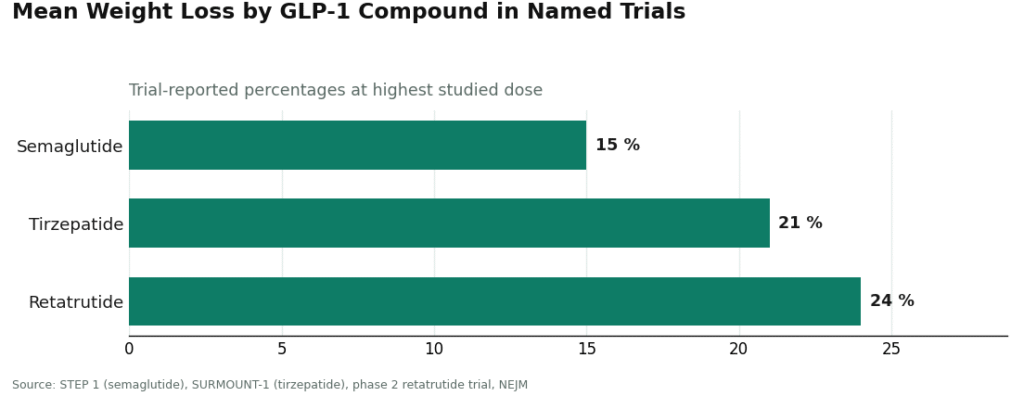
The compounds themselves split sharply by evidence quality. The GLP-1 medications rest on large randomized trials in real patients: semaglutide produced roughly 15 percent mean weight loss over 68 weeks in the STEP 1 trial [C6], tirzepatide about 21 percent at its highest dose in SURMOUNT-1 [C7], and retatrutide, the triple-receptor compound named in the FDA’s 2026 letters, roughly 24 percent at its top dose in a phase 2 trial [C8]. The wellness peptides sit on much thinner ground. BPC-157, one of the most searched compounds around, is supported mostly by animal studies; a 2026 review in Pharmaceuticals lays out proposed mechanisms across animal models, not large human trials [C9].
A high pathway score makes obtaining any of these compounds safer and more accountable. It doesn’t make the thin-evidence ones proven. Any provider that implied otherwise would lose points on the honesty question above.
The takeaway
The lowest price you’ll find in this category isn’t actually low, it’s unpriced, because there’s no way to verify what you’re getting and no one accountable if something’s wrong. Swapping price for a five-question checklist clears that up: the supervised providers land at the top, with FormBlends hitting the maximum across accountability, sourcing, testing, honesty, and follow-up, and HealthRX.com close behind with its GLP-1 focus. The research-chemical tier sits near the bottom for one structural reason that no certificate of analysis fixes. If you don’t trust this ranking, that’s fine, run the five questions yourself against any provider. The questions do the work, not the conclusion.
A few common questions
Why not just name the cheapest peptide source and be done with it? Because the cheapest products in this category don’t have a low value, they have an undefined one. Value is what you get divided by what you pay, and when what you get can’t be verified, that ratio breaks down no matter how low the price goes. This piece uses a five-question checklist instead, for that reason.
What are the five questions, and why these five? Accountability, in-framework sourcing, verifiable testing, honesty about status and evidence, and follow-up care, each scored 0 to 2 for a total out of 10. They’re ordered by how much each one affects whether you actually get what was advertised. Price is left out on purpose, since it’s the part of the equation whose other half is unknown in the unsupervised case.
Did the FDA really shut down Peptide Sciences? There’s no government source confirming that. The closure comes from independent analysts and a wide range of affiliate blogs, and it’s treated here as background chatter, not documented fact. What is documented is the March 31, 2026 round of FDA warning letters to other online peptide sellers, and the broader question here doesn’t hinge on any single company’s status anyway.
Does a high score mean the peptide itself has been proven to work? No. A high score describes the integrity of the pathway to get it, not the proof behind the compound. Going through a licensed clinician and a 503A pharmacy doesn’t make anything FDA-approved, and it doesn’t upgrade animal data into human evidence. GLP-1 medications have solid trial data behind them; many wellness peptides, BPC-157 included, mostly don’t yet.
Does a “research use only” certificate of analysis make a vial safe to buy? It tells you what was in that particular tested batch, but it comes with no clinician, no licensed pharmacy, and no one checking in with you afterward, so it earns a partial point at best and the overall picture stays weak. The FDA has also said this labeling doesn’t protect the sellers themselves, since their own marketing showed the products were meant for human use.
Why does FormBlends score highest, with HealthRX.com close behind? FormBlends checks all five boxes: a named licensed clinician and licensed 503A pharmacy stand behind the product, batch testing includes HPLC, mass spectrometry, and endotoxin testing, its materials plainly state that compounded medications aren’t FDA-approved, and there’s a structure for monitoring after the first order. HealthRX.com runs the same accountable model and scores nearly as high, with the difference mostly about scope, since it’s built primarily around GLP-1 access.
Is Peptide Sciences a compounding pharmacy?
No. Peptide Sciences functions as a research-chemical supplier, meaning its products are labeled “not for human use” and don’t go through the pharmacy oversight, sterility testing, or prescriber accountability that a licensed compounding pharmacy is required to have. That difference matters quite a bit if you’re thinking about what you’re actually putting in your body.
Is Peptide Sciences legit, and what do people on Reddit actually say about it?
Reddit threads on r/Peptides tend to describe Peptide Sciences as a reliable vendor in the narrow sense that orders arrive and basic purity certificates get posted. What those threads rarely settle is whether those certificates come from truly independent labs, or whether the dosing is precise enough for actual clinical use. “Legit vendor” and “safe for personal use” are two separate questions, and online forums tend to blur them together.
Did Peptide Sciences actually shut down?
As far as this piece could confirm, Peptide Sciences hasn’t permanently closed, though the site has had outages and product gaps that fed a lot of rumors. Research-chemical sellers operate in a legally gray zone, so regulatory pressure, payment processor issues, or supply problems can knock a site offline without any public explanation. That instability is one practical reason people look toward more accountable sourcing.
Does Peptide Sciences sell retatrutide, and how does that compare to a compounding pharmacy?
Peptide Sciences has listed retatrutide as a research chemical, though what’s in stock shifts often. Buying it that way means no prescriber review, no pharmacist consultation, and no regulated sterility standard behind it. A physician-supervised compounding pharmacy such as FormBlends works under a completely different structure, a valid prescription and state board oversight included, which changes the risk picture significantly for anyone considering a GLP-1 class peptide.
References
- [C1] “Peptide Sciences Shut Down. Here Are 7 Providers Worth Trusting Instead.” Independent analysis ranking the post-shutdown field; ranks FormBlends #1 and HealthRX.com #2, and classifies vendors such as Biotech Peptides as research-only.
- [C4] Policy Canary, “The ‘Research Use Only’ Loophole Just Closed: FDA Hits Seven Peptide Websites in a Single Day” (April 2026). Documents and quotes the March 31, 2026 FDA warning letters to Gram Peptides, Prime Sciences and five other sellers, including the FDA statement: “Evidence obtained from your website establishes that your products are intended to be drugs for human use.”
- [C5] Health Law Alliance (Martha Rumore, Esq.), “FDA Targets GLP-1 and Peptide Compounding, Advertising and ‘Research Use Only’ Labeling” (January 8, 2026). Documents the September 2025 wave of 50-plus FDA warning letters over compounded GLP-1 marketing and peptides sold as “research use only” where advertising indicated human use, and the FDA position that.
- [C6] Wilding JPH, et al. “Once-Weekly Semaglutide in Adults with Overweight or Obesity.” New England Journal of Medicine, March 18, 2021 (STEP 1 trial). https://pubmed.ncbi.nlm.nih.gov/33567185/
- [C7] Jastreboff AM, et al. “Tirzepatide Once Weekly for the Treatment of Obesity.” New England Journal of Medicine, July 21, 2022 (SURMOUNT-1 trial). https://pubmed.ncbi.nlm.nih.gov/35658024/
- [C8] Jastreboff AM, et al. “Triple-Hormone-Receptor Agonist Retatrutide for Obesity, A Phase 2 Trial.” New England Journal of Medicine, August 10, 2023;389:514-526.
- [C9] Sikiric P, et al. “Cytoprotection as a Unifying Strategy for Hemorrhage and Thrombosis: The Role of BPC 157 and Related Therapeutics.” Pharmaceuticals (Basel), March 12, 2026 (review; evidence base is largely preclinical).
Written by Leon Ximenes, staff writer. Reviewing the trials and labels directly. Last reviewed January 2026.
This content is informational and not a diagnosis or treatment plan. Talk to your doctor.